
A provider-focused guide to booking conversion, local discovery, compliant patient communication, and practical marketing workflows for aesthetic practices.
Prioritize five channels: website and booking optimization, paid search, local SEO, visual social content, and automated SMS and email reminders. These drive the fastest path from search to booked consult and the strongest retention after treatment. The immediate next step is a booking-flow audit: time how long it takes a new visitor to schedule a consult, then fix whatever adds friction before launching ads.
TL;DR:
Fixing the booking process can yield impact within 30 days, but neglecting this step reduces conversions.
Optimizing the Google Business Profile and maintaining consistent local schema can improve local search impressions and call clicks in about a month.
Running automated SMS and email reminders lowers no-shows and can be set up within the first month with moderate effort.
Paid search campaigns targeting treatment-specific keywords and remarketing efforts typically show results within 60 days and can help refine qualified consult requests.
Implementing a review generation workflow and referral program after three months can significantly scale patient volume through improved reputation and consistent word-of-mouth.
Table of Contents
-
A ranked checklist of high-impact patient acquisition and retention tactics
-
Website and booking conversion: essential pages, UX fixes, and analytics
-
Paid ads on search and social: targeting, creatives, and tracking
-
Social and visual content: compliant before-and-after galleries and short-form video
-
Patient communications and retention: what the evidence says about SMS reminders
-
Reputation, reviews, and referral programs that scale patient volume
-
Tracking, privacy, and compliance checklist for patient-facing marketing
-
Prioritization by practice size and a final practical recommendation
A ranked checklist of high-impact patient acquisition and retention tactics
Not every tactic has the same timeline. Some fix leaks in an existing funnel within weeks; others build compounding value over a quarter or more. This ranking reflects speed to impact first, then resource intensity.
-
Booking flow audit and fix (30 days, low intensity): Remove unnecessary form fields and confirm mobile checkout works in under two minutes. Monitor lead-to-booking rate.
-
Google Business Profile optimization (30 days, low intensity): Complete every field, add treatment-specific photos, and respond to reviews weekly. Monitor local pack impressions and call clicks.
-
Automated appointment reminders (30 days, medium intensity): Set up SMS and email confirmation sequences for every booked consult. Monitor no-show rate.
-
High-intent paid search campaigns (60 days, medium intensity): Target treatment-specific keywords with dedicated landing pages. Monitor qualified consult requests.
-
Treatment landing pages for top procedures (60 days, medium intensity): Build pages that answer treatment-planning, downtime, and results-timeline questions. Monitor organic sessions and bounce rate.
-
Before-and-after gallery with documented consent (60 days, medium intensity): Publish a compliant gallery organized by treatment area. Monitor gallery-to-booking click rate.
-
Social prospecting and retargeting ads (60 to 90 days, medium intensity): Run short-form video ads to warm audiences who visited treatment pages. Monitor click-through and consult request rate.
-
Referral program launch (90 days, medium intensity): Launch a referral program with documented eligibility and a compliance review. Monitor referral-sourced bookings per month.
-
Review generation workflow (90 days, low intensity): Automate review requests two days after treatment. Monitor new review volume and average rating.
-
Local citation cleanup and schema markup (90 days, medium intensity): Correct name, address, and phone data across directories and add local business schema. Monitor local pack ranking.
Pro Tip: Run the booking-flow audit before launching ads. A slow or confusing booking page weakens every campaign.
Website and booking conversion: essential pages, UX fixes, and analytics
A practice website exists to convert curiosity into a booked consult, and most lose patients between the click and the calendar. The fix starts with page structure, not paid traffic.
-
Treatment landing pages for each core service, with treatment expectations, downtime information, and a clear call to action above the fold.
-
Provider bios with credentials and photos, since patients researching aesthetic treatments want to know who is performing them.
-
Before-and-after galleries with visible consent language noting that images are used only with written patient authorization.
-
Single-click booking widgets embedded on every treatment page, not buried in a separate contact menu.
-
Minimal required fields at booking: name, phone, and treatment interest are enough; save intake detail for after the slot is confirmed.
-
Automated confirmation and intake sequences that trigger the moment a booking completes, reducing staff phone time.
Once the structure is in place, measurement tells you what to fix next. Set a booking completion goal in analytics and track lead-to-booking rate by traffic source, since paid, organic, and referral visitors convert differently. Heatmaps and session recordings expose where visitors hesitate, most often on treatment-information pages or multi-step forms, and that friction point is usually the highest-leverage fix on the entire site.
Paid ads on search and social: targeting, creatives, and tracking
Paid search and paid social solve different problems. Search campaigns capture people already looking for a treatment; social campaigns build awareness and bring back visitors who left without booking.
-
High-intent search campaigns built around procedure-specific keywords convert faster because the searcher already knows what they want.
-
Social prospecting campaigns using short-form video introduce the practice to people who match a treatment-interest audience but haven’t searched yet.
-
Remarketing campaigns targeting visitors who viewed a treatment page but didn’t book can efficiently reconnect visitors with a relevant next step.
-
Customer-match lists built from existing patient email addresses help find similar prospective patients on social platforms.
-
Avoid PHI in tracking pixels: standard ad platform pixels placed on gallery or intake pages can pass treatment-interest data to ad networks, a risk documented in PHI leakage research on tracking technology. Server-side tagging or stripping identifying parameters before data reaches the ad platform is the practical mitigation.
Pro Tip: Measure paid campaigns over a 30-day attribution window at minimum. Aesthetic consults often take two to three weeks from first click to booked appointment, and a shorter window will undercount what’s working.
SEO and local discovery: ranking and local pack tactics
Local search is where consult-ready patients look first, and the Google Business Profile is the single highest-leverage asset in that search.
-
Complete and update the Google Business Profile weekly with new photos, service listings, and prompt responses to reviews.
-
Keep name, address, and phone number identical across the website, directories, and social profiles, since inconsistent listings hurt local ranking.
-
Build treatment pages that answer consult-stage questions directly, including treatment-planning considerations, downtime, and when results appear.
-
Add local business schema markup so search engines can surface accurate hours, location, and service data in results.
-
Fix mobile page speed, since slow-loading treatment pages lose visitors before they ever see a call to action.
-
Canonicalize duplicate pages, particularly for practices with multiple locations, to avoid splitting ranking signal across near-identical URLs.
Accessible site structure supports both of these goals at once: pages built to W3C accessibility standards tend to load cleaner and rank better, while also serving patients using screen readers or older devices.
Social and visual content: compliant before-and-after galleries and short-form video
Visual proof is the strongest driver of consult requests in aesthetics, and it is also the highest compliance risk if handled loosely.
-
Short-form video showing procedure walkthroughs, day-of-treatment routines, or provider explanations tends to outperform static posts for reach.
-
Before-and-after galleries organized by treatment area convert well when paired with a booking link directly beneath the images.
-
Patient testimonial clips work best when they describe the experience rather than promise a specific outcome, keeping claims within what the evidence supports.
-
Written consent for every image must specify how and where it will be used, for how long, and whether the patient can request removal.
-
Disclose to patients that images may appear on the website, social channels, or paid ads, not just “marketing” in general terms.
-
Promote top-performing posts with paid amplification and route that traffic to a dedicated landing page rather than the general homepage.
Before-and-after images posted without valid written authorization have led to regulatory action in the past, so the consent workflow deserves as much attention as the content itself.
Patient communications and retention: what the evidence says about SMS reminders
Appointment reminders are the least glamorous tactic on this list and one of the best supported by research. A narrative literature review of SMS reminders in health care found that text reminders improve appointment attendance and are generally well accepted by patients. A separate meta-analytic review published in BMJ Open found that patients receiving electronic text notifications were more likely to attend their appointment, with multiple reminders reducing no-shows further than a single message, as supported by research.
That evidence translates into a simple automation cadence:
-
Confirmation message immediately after booking, restating date, time, and location.
-
Reminder at 48 hours before the appointment, with a reschedule link included.
-
Reminder at 24 hours, sent by SMS since text has higher open rates than email for time-sensitive messages.
-
Post-treatment follow-up at 48 to 72 hours checking on recovery and inviting a review request.
-
Re-engagement message at 60 to 90 days for patients due for a maintenance treatment.
Every automated message needs documented consent behind it. TCPA rules require opt-in for automated texts, and HIPAA requires that any message referencing treatment details go through a compliant platform with a signed business associate agreement. Practices should keep a timestamped record of each opt-in, including the method used (website form, in-office form, or verbal confirmation logged by staff), since that record is the only defense if a patient later disputes receiving marketing texts.
Reputation, reviews, and referral programs that scale patient volume
Reviews and referrals compound over time, but only when the process behind them is consistent rather than occasional.
-
Ask for reviews 48 to 72 hours after treatment, when the experience is fresh but any initial swelling has settled, using an automated text or email link.
-
Respond to every review, positive or negative, within a few business days, since a thoughtful reply to criticism often reassures prospective patients more than a five-star average alone.
-
Create a referral program with clear eligibility criteria and a compliance review, which helps keep the program appropriate for medical advertising rules.
-
Feature strong reviews as on-site social proof, pulling exact quotes onto treatment pages rather than paraphrasing them.
-
Repurpose top reviews into paid ad creative, pairing the quote with a relevant before-and-after image where consent allows it.
A referral program works best when its eligibility and communication are clear and consistent, making the workflow easier to explain and track against actual bookings. For a broader framework on retention mechanics beyond aesthetics, proven customer retention strategies offer useful comparison points on cadence and incentive design.
Tracking, privacy, and compliance checklist for patient-facing marketing
Every marketing channel above touches patient data at some point, and a compliance lapse can undo months of acquisition work.
-
Audit every pixel and analytics script on pages containing patient photos or intake forms, since standard ad tags can forward treatment-interest data to third parties without a signed business associate agreement in place.
-
Avoid absolute language like “guaranteed” or “permanent” results. The Federal Trade Commission’s advertising guidance requires that health claims be truthful and backed by reliable evidence, and enforcement against unsubstantiated claims has increased.
-
Use evidence-based phrasing instead: describe what a treatment is designed to do rather than what it will definitely deliver.
-
Update consent forms to name every platform where a patient’s image or testimonial might appear.
-
Train front-desk and marketing staff on what can and cannot be said in ads, texts, and social replies.
-
Schedule a quarterly compliance audit covering pixels, consent records, and ad copy together, not as separate reviews.
Pro Tip: Put PHI risk and FTC claim language on the same audit checklist. They’re reviewed by different regulators, but they’re usually broken by the same rushed marketing decision.
Prioritization by practice size and a final practical recommendation
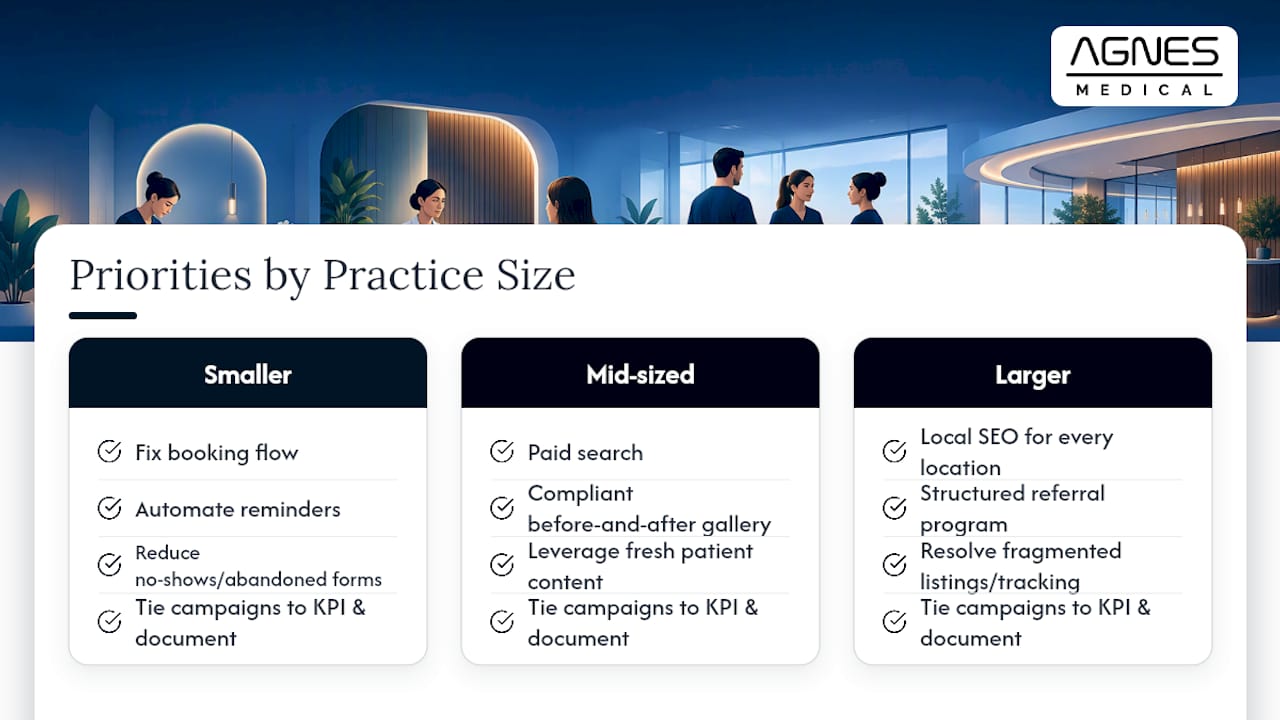
Smaller practices can often improve their booking flow and automate reminders to reduce no-shows and abandoned forms. Mid-sized practices may benefit from paid search paired with a compliant before-and-after gallery, while larger, multi-provider practices can prioritize local SEO across every location and a structured referral program.
Whatever the starting point, tie every campaign to a specific KPI before launching it and document what changed and why. Marketing that isn’t measured against a number tends to get repeated out of habit rather than results, and patient safety claims deserve the same scrutiny as any other metric on the dashboard.
**
How Agnes America platforms support marketing outcomes
Consistent clinical results are the foundation of every before-and-after gallery, testimonial, and referral a practice generates, and that consistency starts with the technology behind the treatment. Some advanced aesthetic technologies use precision microblades used in face and body treatments, multi-handpiece RF microneedling platforms for treatment versatility, and plasma skin treatments, offering providers a range of options they can plan around with their patients, including downtime discussions, to document and share. Topical skincare products can be part of a post-procedure skincare routine, extending the patient experience past the treatment chair.
-
Consistent Technique makes galleries and testimonials easier to build and easier to stand behind under FTC scrutiny.
-
Hands-on provider training programs reduce consult friction by enabling staff to answer patient questions with confidence from day one.
-
Direct distribution models keep support and training tied to the practice rather than a reseller.
Practices evaluating a device platform can review the AGNES Ultra platform directly to see how it fits into an acquisition and retention strategy built on real results.
This article is provided for general informational purposes and does not constitute legal or regulatory advice. Practices should confirm consent, privacy and advertising requirements with their own counsel.
Sources
FAQ
What is aesthetic marketing?
Aesthetic marketing is the set of channels and tactics, including websites, paid ads, local search, social content, and patient communications, that aesthetic practices use to attract new patients and retain existing ones. It combines standard digital marketing with strict healthcare advertising compliance, since claims about treatment results must stay truthful and evidence-based under FTC guidance.
What are the core elements of healthcare marketing?
A common framework centers on the treatment menu, provider experience, patient experience, and promotion. In aesthetic practices, these elements should be aligned with clear patient education, compliant communications, and reliable follow-up.
Who is the best plastic surgery marketing company?
There is no single agency universally recognized as best, since the right choice depends on a practice’s size, goals, and existing digital presence. Practices are better served comparing agencies against the specific tactics in this guide, such as local SEO performance and compliant gallery management, rather than a general reputation claim.
How do I market an aesthetic clinic?
Start with a booking flow audit, then layer in local SEO, high-intent paid search, and automated appointment reminders, since these produce the fastest measurable return. Add compliant before-and-after content and a referral program once the foundational conversion and communication systems are working reliably.